How does a Georgia shipper find out that a refrigerated load is warming before the trailer backs into an Atlanta receiving dock? That question sounds like a hardware question. It almost never is.
The Hours Between Savannah Close-Out and an Atlanta Receiving Appointment
A Savannah-to-Atlanta perishable move is a same-day run up I-16 and I-75, typically a four- to six-hour window from close-out at the loading dock to the receiving appointment. Treat that window as one number and you have described almost nothing. Treat it as three custody intervals and the gaps show up immediately.
The first interval ends when the doors close. The second is the road move, where nobody is looking at the product. The third starts when the trailer is spotted in Atlanta and somebody puts a probe in a case.
Here is the trap: a clean setpoint reading at loading and a clean dock reading at arrival can sit hours apart with no product-core observation in between. Both numbers can be perfectly defensible. Neither one proves continuous control.
Two data streams matter and they are not interchangeable. Trailer-air temperature tells you what the reefer unit is circulating. Product temperature tells you what the commodity experienced. A pallet packed tight against a sidewall behaves differently from the case sitting under the discharge air. Keep both streams; neither describes every location in the load.
Write Down the Commodity Specification Before You Shop for Loggers
The most expensive mistake I see on these projects is buying devices first. Catalog browsing feels like progress. It isn't.
Define five things in writing before a single purchase order moves: the product, the packaging, the route, the expected trip duration, and the commodity's documented temperature specification. Thresholds come from that specification, not from a round number somebody remembers from a previous job.
Only then compare device classes:
- Calibrated trailer-air sensors — good for reefer performance, blind to pallet cores.
- Independent data loggers, a record that does not depend on the carrier's telematics, but someone has to retrieve them.
- Product-proximate probes, closest to the truth, hardest to place consistently.
Placement risk deserves its own review. A sensor parked in the discharge airstream reads optimistically. A sensor near the doors reads every dock cycle as an excursion. A sensor buried in a densely packed pallet may lag real conditions by a long time.
On perishable reefer work, sampling cycles are set from the commodity specification and commonly land in the five- to fifteen-minute range. Battery life has to cover the full trip plus dwell. Calibration records have to exist and be retrievable.
I-16 Coverage GapsRural stretches of this corridor will drop cellular service. Any logger you select needs an offline buffer that holds readings through multi-hour gaps and uploads the full series once coverage returns. A device that only streams live is a device that loses the part of the trip you most wanted to see.
No sensor corrects a poorly pre-cooled trailer or a sloppy load pattern. It documents them.
From a Temperature Spike to Somebody Actually Doing Something
Draw the path as named handoffs: device, connectivity service, monitoring platform, dispatch, carrier, receiving site. Each arrow is a place where an alert can die quietly.
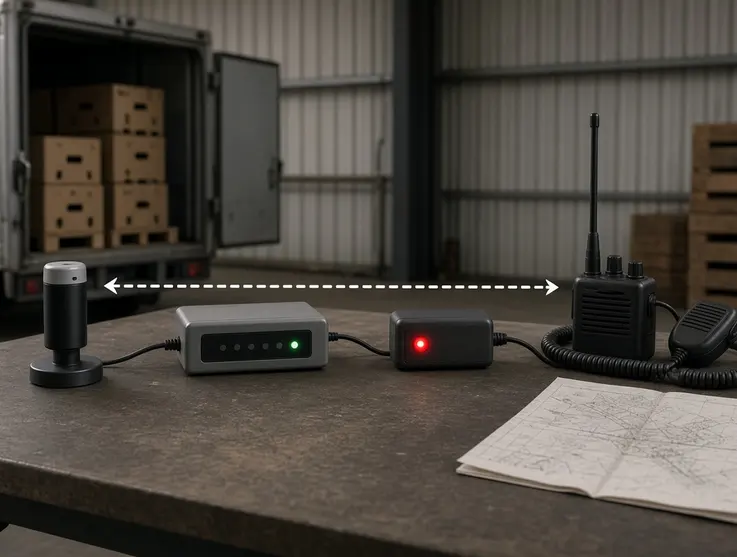
An alert that says "temperature high" is noise. Require five fields in every payload: shipment identifier, sensor location, timestamp, reading, and escalation contact. With those, a dispatcher can name the trailer and call the right driver in under a minute.
Then write the review rule down. A brief door-opening spike during a fuel stop and a sustained excursion over the specification are different events with different consequences, and the distinction cannot live in one experienced dispatcher's head. Document the duration and magnitude that separate them.
Assign the verbs to people. Who acknowledges? Who confirms the reefer is running and at setpoint? Who decides whether the load gets held for assessment at Atlanta? Acknowledgment is expected while the trailer is still westbound, not after check-in at the dock.
Making Sensor IDs Match the Trailer Numbers Your Staff Already Use
Map sensor identifiers onto the transport-management and warehouse keys your team already lives in. Otherwise you have built a parallel filing system that nobody opens during an actual problem.
Pilot scope should be one defined Savannah-to-Atlanta movement. Not a statewide rollout. Four checkpoints:
- Device activation confirmed at loading.
- Alert delivery in transit, to a human who responds.
- Offline data recovery after a coverage gap.
- Record access at the Atlanta dock, including the event history from any offline interval.
Document the ugly cases while they are fresh: swapped trailers, late departures, lost connectivity, devices pulled before unloading. Write the procedure for a shipment that arrives with no usable readings, because that shipment will happen and the receiving team should not be improvising.
What the Sanitary Transportation Rule Does and Doesn't Settle
The FDA sanitary transportation rule, finalized in 2016, is the regulatory context for covered food shipments. Covered-food status, vehicle type, and each party's role determine whether a particular Georgia perishable move falls under it and who carries which responsibility.
Installing monitors does not create coverage, and it does not establish compliance. Retain time-stamped readings, calibration information, alerts, acknowledgments, and corrective-action notes according to the applicable requirements and your own written procedures.
On the science side, the 2017 review by Mercier and colleagues on time-temperature management along the food cold chain is a useful synthesis of how thermal load behaves across the chain. General findings from a review are a starting point for discussion; the requirements that govern a specific commodity on this lane are a separate determination. One pilot on one corridor with one product does not generalize to every Georgia perishable.
Scoring the Pilot on Decisions, Not Device Count
Ask four questions. Could the team name the affected load? Did the alert arrive with enough runway to act? Did readings survive the connectivity gap? Did Atlanta receiving get a usable event history? Four yeses is a pass. Anything less points at a fixable thing: placement, alert rules, or escalation contacts. Revise those before adding another route or another commodity — the state's Centers of Innovation network exists partly to help logistics operators work through exactly this kind of sector-specific sequencing.
A reefer's return-air sensor samples the air coming back to the unit. Nothing more. On a four-hour run with peaches, that reading can sit comfortably inside specification while the thermal center of a tightly stacked pallet tells a different story entirely.